Producción científica y su aporte a la innovación educativa en el Desarrollo Regional de Amazonas
DOI:
https://doi.org/10.55996/manguar.v4i2.362Palabras clave:
Plan de desarrollo, tecnología, educación, amazonasResumen
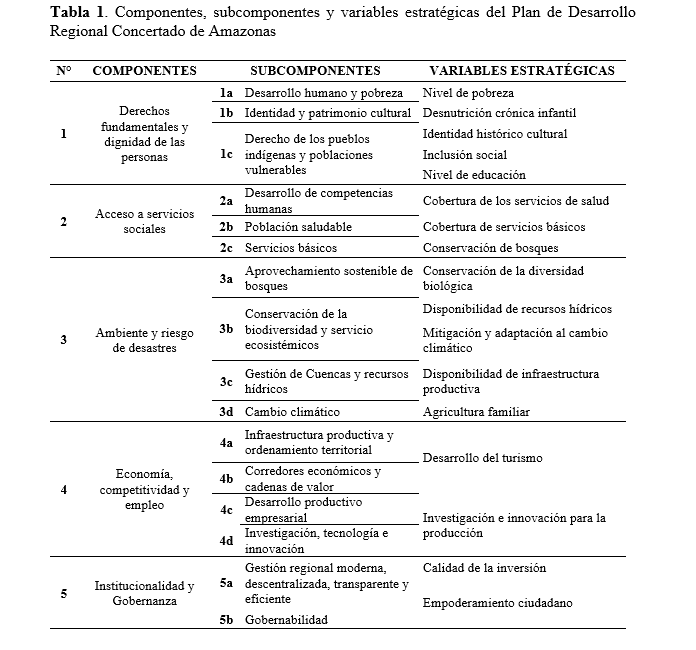
La investigación analizó la producción científica de dos universidades públicas de la región Amazonas y su aporte a la innovación educativa y al desarrollo regional, en el marco del Plan de Desarrollo Regional Concertado (PDRC). Se revisaron 42 artículos indexados en Scopus entre 2020 y 2025, de los cuales 32 corresponde a la Universidad Nacional Toribio Rodríguez de Mendoza (UNTRM) y 10 a la Universidad Nacional Intercultural Fabiola Salazar Leguía (UNIFSL). Los artículos fueron clasificados en los cinco componentes del PDRC, evidenciándose un incremento sostenido en la producción, con un punto máximo en 2024. Los resultados mostraron que la mayor concentración de publicaciones se ubicó en el componente C4 (Economía, competitividad y empleo), particularmente en el subcomponente de investigación, tecnología e innovación, seguido del C2 (Acceso a servicios sociales) y el C1 (Derechos fundamentales y dignidad de las personas). En contraste, los componentes C3 (Ambiente y riesgo de desastres) y C5 (Institucionalidad y gobernanza) tuvieron escasa representación. El análisis de coocurrencia de palabras clave reveló la prevalencia de términos como educación, interculturalidad y tecnologías emergentes, lo que reflejó una orientación hacia enfoques innovadores y culturalmente pertinentes. Se identificó que la UNTRM lideró en número de publicaciones relacionadas con innovación tecnológica y educativa, mientras que la UNIFSL destacó en estudios vinculados a interculturalidad y poblaciones vulnerables. Se concluyó que la producción científica tuvo un impacto positivo en la innovación educativa y en la transformación institucional de Amazonas; no obstante, se requirió diversificar las líneas de investigación hacia sostenibilidad ambiental, gobernanza y equidad social.
Descargas
Citas
Alonso, R., Cano, J., Quispe, R., & Santa Cruz, K. (2024). EL DESARROLLO SOSTENIBLE Y SU IMPLICANCIA EN LA AMAZONIA PERUANA. UNA REVISIÓN SISTEMÁTICA. Revista Aula Virtual, ISSN: 2665-0398; Periodicidad: Continua, 5. https://doi.org/10.5281/zenodo.11301897
Bardales, E., Carrasco, A. M., Marín, Y., Caro, O., Fernández, M., & Santos, R. (2025). Determinants of academic desertion: A case study in a Peruvian university. Power and Education. https://doi.org/10.1177/17577438241312617
Burga, J. M., Ruiz, R. E., Manríquez, H. M., Ccanto, F. F., & Paredes, O. J. (2024). The Impact of Extracurricular Activities and Creativity on Academic Performance of Peruvian Elementary Students. International Journal of Society, Culture and Language, 12(1), 176–186. https://doi.org/10.22034/ijscl.2023.2008400.3117
Cachay, W. (2025). Philosophy for children (PfC) and development of critical-creative thinking. European Public and Social Innovation Review, 10. https://doi.org/10.31637/epsir-2025-1511
Chancahuana, M., Carrasco, O. J., Escobedo, J. D., & Díaz, Y. A. (2023). Formative research in the development of research skills in university students. Revista de Ciencias Sociales, 29(4), 402–414. https://doi.org/10.31876/rcs.v29i4.41264
Chávez, R., Cruz, O., Reina, Y., Sánchez, E., & Carrasco, A. M. (2024). Bibliometric exploration of Intercultural Bilingual Education: an analysis of scientific production and its implications. Cogent Social Sciences, 10(1). https://doi.org/10.1080/23311886.2024.2365973
Chávez, R., Reina, Y., Carrasco, A. M., Sánchez, E., Oviedo, J. A., Carranza, R., & Chávez, Y. T. (2024). Process of Inclusion of Students From Ethnic Communities In Conventional University Education. Journal of Intercultural Communication, 24(4), 97–114. https://doi.org/10.36923/jicc.v24i4.920
Chávez, R., Reina, Y., Sánchez, E., Cruz, O., & Carrasco, A. M. (2025). Analysis of Intercultural Bilingual Education In Indigenous Communities: A Case Study In Regular Basic Education. Journal of Intercultural Communication, 25(2), 218–236. https://doi.org/10.36923/jicc.v25i2.1138
Chotón, M. D. R., Auquiñivin, E. A., Zuta, V., & Cruzalegui, R. J. (2022). Employment status of graduates from public universities in Peru. Revista Venezolana de Gerencia, 27(8), 995–1008. https://doi.org/10.52080/rvgluz.27.8.17
CONCYTEC. (2022). Consejo Nacional de Ciencia, Tecnología e Innovación. https://www.gob.pe/concytec
Condeso, S., Castillo, F., Cuenca Nancy, & Otero, P. (2025). Innovación y digitalización en la educación: un enfoque de revisión sistemática.
Coronado, W., Pérez, C., Sime, A., López, Y., Salazar, J., & Castro, G. (2024). Enhancing Mathematics Education in Engineering Schools: Didactic Strategies for Effective Development. Proceedings of the LACCEI International Multi-Conference for Engineering, Education and Technology. https://doi.org/10.18687/LACCEI2024.1.1.411
Cueva, E., Chauca, P., Zumaeta, M. R., & Cruz, O. (2023). Public management and development of the education and health sector of the amazon region, Peru. Revista Venezolana de Gerencia, 28(104), 1486–1503. https://doi.org/10.52080/RVGLUZ.28.104.7
Estrada, E. G., Ayay, G., Cruz, E. O., & Paricahua, J. N. (2024). Academic stressors and the lifestyles of university students: A predictive study at a public university. Retos, 59, 1132–1139. https://doi.org/10.47197/retos.v59.109410
Estrada, E. G., Sillo, J., León, L. B., Incacutipa, D. J., Ticona, E., Avilés, B., Apaza, J. L., Yucra, T., Pachacutec, R., & Baez, J. F. (2024). Emotional State During the Post-Pandemic Period: Psychological Capital and Academic Engagement in University Students. Journal of Higher Education Theory and Practice, 24(1), 117–126. https://doi.org/10.33423/jhetp.v24i1.6765
Farro, J. L., Rojas, E. E., Bazán, H. P., & Lázaro, E. S. (2024). Family violence and self-esteem in students of a rural educational institution in Amazonas, Peru. Revista Venezolana de Gerencia, 29(12), 1048–1066. https://doi.org/10.52080/rvgluz.29.e12.11
García, J. P. (2020). Implementation of Programas de Desarrollo con Enfoque Territorial (Development Programmes with a Territorial-Based Focus) and territorial peacebuilding in Colombia: Progress and challenges. Revista de La Facultad de Derecho y Ciencias Politicas, 50(133), 454–481. https://doi.org/10.18566/rfdcp.v50n133.a10
Grandez, D. E., Pachas, M., Cristobal, J., Chapa-Gonza, S., Mori, R. C., & Guadalupe, G. A. (2025). Recirculating Aquaculture Systems (RAS) for Cultivating Oncorhynchus mykiss and the Potential for IoT Integration: A Systematic Review and Bibliometric Analysis. Sustainability, 17(15), 6729. https://doi.org/10.3390/su17156729
Hinojosa, C. A., Hernández, M. de J., Polo, B. R., & Morante, M. A. (2022). University social responsibility and the formative process of students in Peru. Revista Venezolana de Gerencia, 27(8), 1082–1097. https://doi.org/10.52080/rvgluz.27.8.23
Hinojosa, C. A., Valdiviezo, V. M., Coronel, F. T., Paco, E., Remuzgo, S. E., & Coronel, S. C. (2024). UNTRM on the Global Scene: A Bibliometric Analysis of its Scientific Production Indexed in Scopus. Journal of Ecohumanism, 3(3), 897–915. https://doi.org/10.62754/joe.v3i3.3397
Huyhua, S. C., Díaz, R. J., Luján, M. N., & Tejada, S. (2024). Social skills in adolescents from virtual teaching: Educational strengthening program in Amazonas-Peru. Revista de Ciencias Sociales, 30(1), 438–451. https://doi.org/10.31876/rcs.v30i1.41666
Icart, B., & Baltar, F. (2010). Desarrollo endógeno, calidad institucional e innovación. Una revisión de la teoría y de algunos de sus límites.
Incio, F. A., Capuñay, D. L., & Estela, R. O. (2023). Artificial Neural Network Model to Predict Academic Results in Mathematics II. Revista Electronica Educare, 27(1). https://doi.org/10.15359/ree.27-1.14516
Izquierdo, L. M., Santos, J. C., Rodriguez, V. H., Espinoza, J. L., Delgado, F. M., & Navarro, L. R. (2023). INTERCULTURAL EDUCATION AND STUDENT CLIMATE IN THE FACULTY OF ORGANIZATIONAL MANAGEMENT, UNIFSL-BAGUA. Journal of Law and Sustainable Development, 11(2). https://doi.org/10.55908/sdgs.v11i2.641
Ley Universitaria N°30220. (2014). LEY UNIVERSITARIA N°30220. https://www.minedu.gob.pe/reforma-universitaria/pdf/ley_universitaria_04_02_2022.pdf
Maquen, G., Aurich, L., Adrianzén, I., De la Cruz, P. E., & Castro, D. (2025). Machine learning model for classifying high school students’ academic performance in mathematics amidst the COVID-19 context. Journal of Technology and Science Education, 15(2), 322. https://doi.org/10.3926/jotse.2945
Marín, Y., Caro, O., Rituay, A. M., Llanos, K. A., Perez, D., Bardales, E., Tuesta, J., & Santos, R. (2025). Ethical Challenges Associated with the Use of Artificial Intelligence in University Education. Journal of Academic Ethics. https://doi.org/10.1007/s10805-025-09660-w
Morales, C. (2015). CONCEPTS AND PRINCIPLES OF THE PRESENT INTERCULTURAL EDUCATION IN TEACHING PRACTICES MADE IN CONTEXT OF RURAL YOUTH INTERACTION METROPOLITAN REGION (CHILE). In No (Vol. 47).
Muro, E., Álvarez, L., Rodriguez, V., Lucana, F., Rojas, L., Benavides, A., & Salazar, C. (2024). FOSTERING EQUITY IN RURAL EDUCATION: A LITERATURE REVIEW ON STUDENT DROPOUT AND RETENTION STRATEGIES. Revista de Gestao Social e Ambiental, 18(1). https://doi.org/10.24857/RGSA.V18N1-083
Naranjo, J., Jiménez, D., & Sanz, R. (2012). ¿Es la cultura organizativa un determinante de la innovación en la empresa? Cuadernos de Economia y Direccion de La Empresa, 15(2), 63–72. https://doi.org/10.1016/j.cede.2011.07.004
Ocaña, C., Tineo, M., Fernandez, F. H., Quiñones, L., Huaccha, A. E., Morales, E., & Miguel, H. W. (2023). Implementing the Sustainable Development Goals in University Higher Education: A Systematic Review. International Journal of Sustainable Development and Planning, 18(6), 1769–1776. https://doi.org/10.18280/ijsdp.180612
Olano, M., De La Cruz, A., Rodriguez, V. H., Santa Cruz, L. D. C., Benavides, A. M., Salazar, C. A., Escobar, B. R., & Reategui, J. (2024). THE NEED FOR INNOVATION IN FINANCIAL EDUCATION: A STUDY OF HOUSEHOLD INDEBTEDNESS IN PERU. Revista de Gestao Social e Ambiental, 18(1). https://doi.org/10.24857/rgsa.v18n1-081
Oviedo, A., Meléndez, A., Zabarburu, S., & Abanto, E. (2025). Awajún Pottery, Gender, and Transformation: From Social Prestige to Market Logic. Journal of Intercultural Communication, 25(3), 104–115. https://doi.org/10.36923/jicc.v25i3.1157
PDRC. (2021). PLAN DE DESARROLLO REGIONAL CONCERTADO DE AMAZONAS. https://cdn.www.gob.pe/uploads/document/file/4294808/PDRC%20%20Ampliado%20al%202027.pdf.pdf?v=1679351012
Pérez, M., & Vladimirovna, N. (2017). LA PRODUCCIÓN CIENTÍFICA SOBRE LA INNOVACIÓN SOCIAL PARA EL DESARROLLO LOCAL: UNA REVISIÓN BIBLIOMÉTRICA LA ESTRUCTURA Y LA EVOLUCIÓN DEL CAMPO DE DOMINIO CIENTÍFICO. https://revistaprismasocial.es/article/view/1750/2331
Rabanal, R., Huaman, R., Valderrama, L., & Chauca, P. (2020). Development of personal and social skills for the labor insertion of university graduates. Revista de Ciencias Sociales.
Reina, Y., Cruz, O., Maicelo, Y. del C., Alva, J. N., Sánchez, E., Carrasco, A. M., & Chávez, R. (2025). Artificial intelligence as a teaching tool in university education. Frontiers in Education, 10. https://doi.org/10.3389/feduc.2025.1578451
Revilla, A., Valdiviezo, V. M., Baique, D. B., Merino, L. G., Reategui, J., & Guevara, R. (2025). Emerging Trends and Gaps in Academic Research: A Bibliometric Study of Economic and Administrative Sciences at UNTRM. Journal of Educational and Social Research, 15(1), 367–382. https://doi.org/10.36941/jesr-2025-0028
Reyna, Y., Sánchez, E., Cruz, O., Carrasco, A., Torres, M., & Chávez, R. (2024). Interculturality In Universities: Identity, Experiences And The Impact of Beca 18 on Bilingual Students. Journal of Intercultural Communication, 24(3), 140–155. https://doi.org/10.36923/jicc.v24i3.953
Ricardo, S., Bueno, M., Herreño, M. L., & Mejía, J. (2025). La producción científica en Latinoamérica: Logros, desafíos y oportunidades. CIENCIAMATRIA, 11(20), 79–103. https://doi.org/10.35381/cm.v11i20.1536
Rituay, A. M., Bardales, E. S., Marín, Y. R., Caro, O. C., & Santos, R. C. (2024). Comprehensive Wellness in University Life: An Analysis of Student Services and Their Impact on Quality of Life. Journal of Educational and Social Research, 14(6), 514–527. https://doi.org/10.36941/jesr-2024-0190
Robalino, M. (2015). Políticas Educativas y Valorización de la Profesión Docente.
Rosas, F., Jimenez, P., & Calderón, J. (2022). Movilidad y desarrollo urbano: una revisión de los factores estratégicos de su gobernanza y sostenibilidad. Revistas Cuadernos de Trabajo de Estudios Regionales En Economía Población y Desarrollo. https://www.researchgate.net/publication/378365396
Ruiz, Y., Sánchez, A. J., Cruz, O., Meza, G., Chávez, R., & Bazán, R. Y. (2025). Student perspectives on quality management and intercultural education: a case study in a public university in the Amazon of Peru. International Journal of Inclusive Education. https://doi.org/10.1080/13603116.2025.2467642
Sánchez, E., Reina, Y., Cruz, O., Torres, M., Carrasco, A. M., & Chávez, R. (2024). Analysis of social demand and labor supply for university study programs: case study in the province of Rodriguez de Mendoza, Amazonas region. Cogent Education, 11(1). https://doi.org/10.1080/2331186X.2024.2406589
Santos, R., Rituay, A. M., Rascón, J., Bardales, E., Marín, Y., Santos, Y. T., & Guevara, R. (2024). The Transformative Power of Environmental Education in the Consumption of Safety: The Case of a Popular Housing Estate. Qubahan Academic Journal, 4(3), 440–453. https://doi.org/10.48161/qaj.v4n3a838
Santos, R., Tejada, J. L., Rituay, A. M., & Noriega, C. (2024). “Positive schools” program: a new comprehensive proposal for emotional education. Revista Electronica Interuniversitaria de Formacion Del Profesorado, 27(3), 85–103. https://doi.org/10.6018/reifop.614341
Sarmiento, F., Oliva, S. M., & Fernandez, S. (2020). Montology: A Transformative Frame for the Future of Education about Mountains. Mountain Research and Development, 40(4), A15–A27. https://doi.org/10.1659/MRD-JOURNAL-D-20-00031.1
Silva, J. C., Pabón, J. A., & Barrientos, E. J. (2021). El desarrollo regional y la sostenibilidad: revisión sistemática y análisis bibliométrico. Revista Universidad y Empresa, 23(41). https://doi.org/10.12804/revistas.urosario.edu.co/empresa/a.10403
Suárez, J. E., Manayay, F., Ruiz, W., & Perales, G. B. (2025). Participatory road infrastructure and Sustainable Development Goals: an andean model for sustainable. Clio. Revista de Historia, Ciencias Humanas y Pensamiento Critico., 5(10), 1633–1654. https://doi.org/10.5281/zenodo.15550344
Tongo, D., Guevara, R. E., Ayay, G., & Cuja, S. (2025). Impact of socio-constructivism on the academic performance of students and teachers in basic education: Evaluation of the approach and Peruvian educational policy. Journal of Education and E-Learning Research, 12(2), 190–198. https://doi.org/10.20448/jeelr.v12i2.6751
UNESCO. (2015). Reporte Anual 2015. www.unesco.org/open-access/
Valdiviezo, V., Hinojosa, C., Gonzales, E., Remuzgo, E., Carhuas, L., & Perez, M. (2024). Research Trends on Digital Marketing Strategies and Student Satisfaction in Higher Education: A Bibliometric Analysis. Journal of Ecohumanism, 3(3), 1587–1597. https://doi.org/10.62754/joe.v3i3.3333
Valdiviezo, V., Revilla, A., Reategui, J., Guevara, R., Pantaleon, A., Medina, E., & Valque, R. (2025). Impact of Social Networks on the Purchasing Decisions and Behavior of University Students: A Quantitative Study in an Emerging Context. Studies in Media and Communication, 13(3), 124–135. https://doi.org/10.11114/smc.v13i3.7623
Valdiviezo, V., Timaná, D., Cava, L., Reategui, J., & Revilla, A. (2024). The Rising Influence of AI in Higher Education: Trends and Insights from a Bibliometric Analysis. Journal of Educational and Social Research, 14(5), 52–67. https://doi.org/10.36941/jesr-2024-0121
Vilchez, D. O., Sir, V. M., Revilla, A. C., Vásquez, L., Reyes, K. A., Reategui, J., Guevara, R., & Pantaleón, A. J. (2025). Emerging Technologies in Process Management and Educational Quality: A Bibliometric Analysis of Public Institutions. Journal of Educational and Social Research, 15(4), 358–372. https://doi.org/10.36941/jesr-2025-0143
Waltman, L., & van Eck, N. J. (2013). Source normalized indicators of citation impact: An overview of different approaches and an empirical comparison. Scientometrics, 96(3), 699–716. https://doi.org/10.1007/s11192-012-0913-4
Descargas
Publicado
Cómo citar
Número
Sección
Licencia

Esta obra está bajo una licencia internacional Creative Commons Atribución 4.0.
LA REVISTA TIENE UNA POLÍTICA DE ACCESO ABIERTO, CONTANDO CON UNA LICENCIA CC (Licencia Creative Commons Atribución-NoComercial-CompartirIgual 4.0 Internacional).
Aquellos autores/as que tengan publicaciones con esta revista, aceptan los términos siguientes:
- Los autores/as conservarán sus derechos de autor y garantizarán a la revista el derecho de primera publicación de su obra, el cuál estará simultáneamente sujeto a la Licencia de reconocimiento de Creative Commons. Por tanto:
___________________________________
Usted es libre de:
- Compartir — copiar y redistribuir el material en cualquier medio o formato.
- Adaptar — remezclar, transformar y construir a partir del material.
- La licenciante no puede revocar estas libertades en tanto usted siga los términos de la licencia.
Bajo los siguientes términos:
-
Atribución — Usted debe dar crédito de manera adecuada, brindar un enlace a la licencia, e indicar si se han realizado cambios. Puede hacerlo en cualquier forma razonable, pero no de forma tal que sugiera que usted o su uso tienen el apoyo de la licenciante.
-
No Comercial — Usted no puede hacer uso del material con propósitos comerciales.
-
Compartir Igual — Si remezcla, transforma o crea a partir del material, debe distribuir su contribución bajo la lamisma licencia del original.
- No hay restricciones adicionales — No puede aplicar términos legales ni medidas tecnológicas que restrinjan legalmente a otras a hacer cualquier uso permitido por la licencia.
_____________________________________________
- Los autores/as podrán adoptar otros acuerdos de licencia no exclusiva de distribución de la versión de la obra publicada (p. ej.: depositarla en un archivo telemático institucional o publicarla en un volumen monográfico) siempre que se indique la publicación inicial en esta revista.
- Se permite y recomienda a los autores/as difundir su obra a través de Internet (p. ej.: en archivos telemáticos institucionales o en su página web) antes y durante el proceso de envío, lo cual puede producir intercambios interesantes y aumentar las citas de la obra publicada. (Véase El efecto del acceso abierto).