Artificial Intelligence as a driver of digital competency development in university students
DOI:
https://doi.org/10.55996/dekamuagropec.v6i2.371Keywords:
Digital literacy; learning; digital competence; higher education; information technologyAbstract
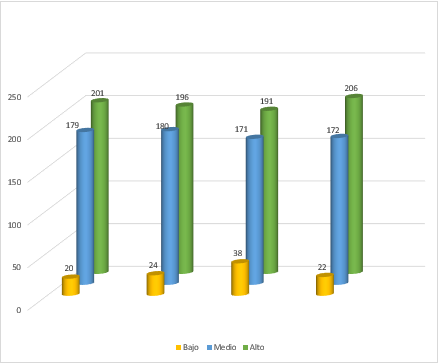
The purpose of this study was to determine the impact of artificial intelligence (AI) on the development of digital competencies among university students. The research employed a quantitative approach with a descriptive–correlational level, using a non-experimental and cross-sectional design. The population consisted of students enrolled in the 2024-II semester at the National University Toribio Rodríguez de Mendoza of Amazonas (UNTRM), with a sample of 400 participants selected through non-probability sampling. Data were collected using two structured Likert-scale questionnaires: one assessing students’ perception and use of AI tools (23 items), and another measuring their level of digital competencies (20 items). The findings revealed that 51.5% of students demonstrated a high level of AI tool usage, while 50.5% reached a medium level of digital competencies. A significant, positive, and moderately strong correlation was found between both variables (Spearman’s Rho = 0.639; p < 0.001), indicating that greater use of AI is associated with better development of digital competencies. It was concluded that artificial intelligence serves as an influential factor in strengthening university students’ digital skills, highlighting the need to integrate these technologies into higher education learning processes.
Downloads
References
Aparicio-Gómez, O.-Y., Ostos-Ortiz, O.-L., & Von Feigenblatt, O. F. (2023). Competencia digital y desarrollo humano en la era de la Inteligencia Artificial. Hallazgos, 20(40), 217–235. https://doi.org/10.15332/2422409X.9254
Cabero-Almenara, J., & Palacios-Rodríguez, A. (2020). Formación y competencias del profesorado en la era digital. Crónica. Revista Científico Profesional de La Pedagogía y Psicopedagogía, 5(5), 113–127. https://dialnet.unirioja.es/servlet/articulo?codigo=7923504&info=resumen&idioma=ENG
European Commission. (2021). Digital Education Action Plan. School Library Systems Association, September 2020, 4–7.
García Sánchez, O. V. (2023). Uso y percepción de ChatGPT en la educación superior. Revista de Investigación En Tecnologías de La Información, 11(23), 98–107. https://doi.org/10.36825/RITI.11.23.009
Goenechea, C., & Valero-Franco, C. (2024). Educación e Inteligencia Artificial: Un Análisis desde la Perspectiva de los Docentes en Formación. REICE. Revista Iberoamericana Sobre Calidad, Eficacia y Cambio En Educación, 22(2), 33–50. https://doi.org/10.15366/reice2024.22.2.002
Guerrero-Quiñonez, A. J., Bedoya-Flores, M. C., Mosquera-Quiñonez, E. F., Ango-Ramos, E. D., & Mesías-Simisterra, Á. E. (2023). Higher Education 4.0: brief considerations. Ibero-American Journal of Education & Society Research, 3(1), 272–275. https://doi.org/10.56183/iberoeds.v3i1.628
Harris Bonet, P., Romero Romero, G., Harris Bonet, M. A., & Llanos Díaz, R. (2022). Análisis de las tendencias educativas con relación al desarrollo de las competencias digitales. Revista Interuniversitaria de Investigación En Tecnología Educativa, 158–174. https://doi.org/10.6018/riite.520771
Larico Hanco, R. (2024). Impacto de la inteligencia artificial generativa chatgpt en la enseñanza universitaria. https://doi.org/10.1590/SciELOPreprints.9332
Levano-Francia, L., Sanchez Diaz, S., Guillén-Aparicio, P., Tello-Cabello, S., Herrera-Paico, N., & Collantes-Inga, Z. (2019). Competencias digitales y educación. Propósitos y Representaciones, 7(2). https://doi.org/10.20511/pyr2019.v7n2.329
López Vicent, P., Martínez De Miguel López, S., & Salmerón Aroca, J. A. (2024). Los ODS y la inclusión social de las personas mayores: una experiencia de innovación educativa con TIC en educación superior. Revista Lusófona de Educação, 61, 175–191. https://doi.org/10.24140/issn.1645-7250.rle61.11
Macías Lara, R. A., Solorzano Criollo, L. R., Choez Calderón, C. J., & Blandón Matamba, B. E. (2023). La inteligencia artificial; análisis del presente y futuro en la educación superior.: Artificial intelligence; analysis of the present and future in higher education. Revista Científica Multidisciplinar G-Nerando, 4(1). https://orcid.org/0000-0003-
Marzal, M. Á., & Vivarelli, M. (2024). The convergence of Artificial Intelligence and Digital Skills: a necessary space for Digital Education and Education 4.0. JLIS.It, 15(1), 1–15. https://doi.org/10.36253/jlis.it-566
Moreno Padilla, R. D. (2019). La llegada de la inteligencia artificial a la educación. Revista de Investigación En Tecnologías de La Información, 7(14), 260–270. https://doi.org/10.36825/RITI.07.14.022
Ocaña-Fernández, Y., Valenzuela-Fernández, L. A., & Garro-Aburto, L. L. (2019). Inteligencia artificial y sus implicaciones en la educación superior. Propósitos y Representaciones, 7(2). https://doi.org/10.20511/pyr2019.v7n2.274
Ojeda del Arco, U. (2021). Informe de competencias digitales de docentes en la educación superior peruana.
Redecker, C., & Punie, Y. (2017). European framework for the digital competence of educators: DigCompEdu. Luxembourg: In Publications Office of the European Union. Publications Office. https://doi.org/10.2760/178382
Regalado, O. (2024). Competencias digitales: un desafío para el mercado laboral peruano. Conexión ESAN. https://www.esan.edu.pe/conexion-esan/competencias-digitales-un-desafio-para-el-mercado-laboral-peruano
Selwyn, N. (2022). Selwyn, N. (2022). Should Robots Replace Teachers? AI and the Future of Education. Polity. Polity Press. https://research.monash.edu/en/publications/should-robots-replace-teachers-ai-and-the-future-of-education/
UNESCO. (2021). AI and education: guidance for policy-makers. In AI and education: guidance for policy-makers. https://doi.org/10.54675/pcsp7350
Downloads
Published
How to Cite
Issue
Section
License
Copyright (c) 2025 Carlos Daniel Velásquez-Correa, Hilda Panduro-Bazán-de-Lázaro, William Riojas-Chozo, Sonia Sánchez-Díaz

This work is licensed under a Creative Commons Attribution 4.0 International License.
Los autores que publican en esta revista aceptan los siguientes términos:
- Los autores conservan los derechos de autor y conceden a la revista el derecho publicación con la obra, simultáneamente licenciada bajo una licencia de Creative Commons CC By que permite a otros compartir el trabajo, pero citando la publicación inicial en esta revista.
- Los autores pueden celebrar acuerdos contractuales adicionales separados para la distribución no exclusiva de la versión publicada de la obra de la revista (por ejemplo, publicarla en un repositorio institucional o publicarla en un libro), pero citando la publicación inicial en esta revista.
- Se permite y anima a los autores a publicar su trabajo en línea (por ejemplo, en repositorios institucionales o en su sitio web) antes y durante el proceso de presentación, ya que puede conducir a intercambios productivos, así como una mayor citación del trabajo publicado (https://web-archive.southampton.ac.uk/opcit.eprints.org/oacitation-biblio.html)