Sensory profile analysis of cup chocolate by descriptive analysis
DOI:
https://doi.org/10.55996/dekamuagropec.v6i2.349Abstract
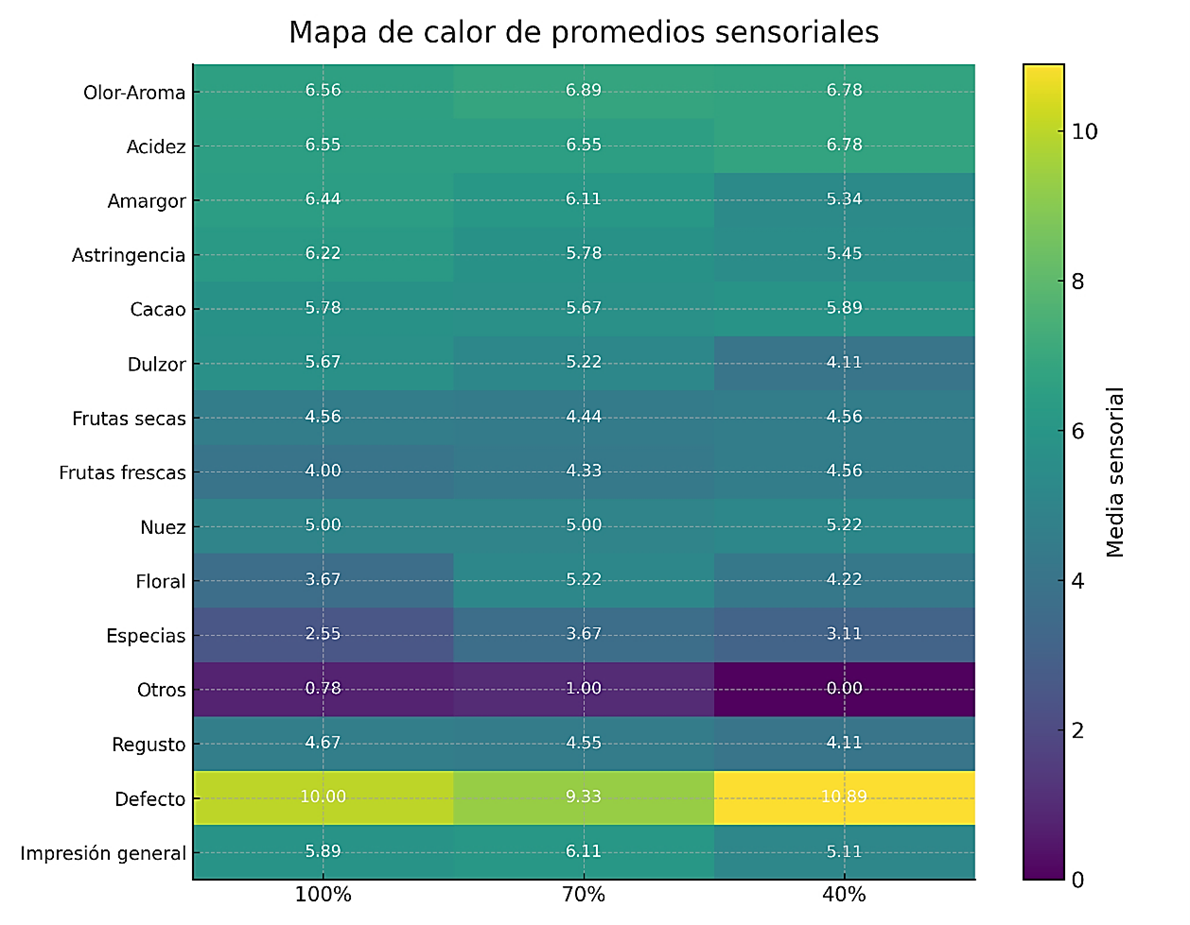
The study aimed to characterize the sensory profile of hot chocolate through expert judgment. This product was produced at the Coffee and Cocoa Production Center of the University Corporation of the National University of Jaén (UNJ). A quantitative descriptive analysis was applied to the three concentrations of cocoa used to make hot chocolate bars (40%, 70%, and 100%). Three certified cocoa liquor tasters were recruited to evaluate the samples based on 15 attributes established in the "Cocoa Liquor Sensory Evaluation Sheet." The results showed a predominance of defects, aroma-smell, and acidity in the three concentrations of hot chocolate. It was concluded that a higher cocoa concentration predominates a sensory profile with high scores for aroma-smell, acidity, bitterness, and astringency. It was also observed that the sample with 40% cocoa received higher scores for perceived defects.
Downloads
References
Bautista Morales, R., Alarcón Pulido, S. A., García Muñoz, S. A., Piña Ramírez, F. J., & Ortega Rodríguez, A. (2021). Propuesta para el establecimiento del cultivo de cacao (Theobroma cacao L) en la zona norte del estado de Veracruz. Revista Biológico Agropecuaria Tuxpan, 9(1), 181–191. https://doi.org/10.47808/revistabioagro.v9i1.350
Bruinsma, K., & Taren, D. L. (1999). Chocolate: Food or Drug? Journal of the American Dietetic Association, 99(10), 1249–1256. https://doi.org/10.1016/S0002-8223(99)00307-7
Bueno-Pérez, S. M. (2023). Determinación de las propiedades ópticas y morfogeométricas de semillas de cacao tipo forastero de diversas cosechas. 5–20.
Castro-Alayo, E. M., Idrogo-Vásquez, G., Siche, R., & Cardenas-Toro, F. P. (2019). Formation of aromatic compounds precursors during fermentation of Criollo and Forastero cocoa. Heliyon, 5(1), e01157. https://doi.org/10.1016/j.heliyon.2019.e01157
Delarue, J., & Sieffermann, J.-M. (2004). Sensory mapping using Flash profile. Comparison with a conventional descriptive method for the evaluation of the flavour of fruit dairy products. Food Quality and Preference, 15(4), 383–392. https://doi.org/10.1016/S0950-3293(03)00085-5
Dos Santos Navarro Da Silva, R. de C., Rodrigues Minim, V. P., Souza Carneiro, J. de D., Nascimento, M., Della Lucia, S. M., & Minim, L. A. (2013). Quantitative sensory description using the Optimized Descriptive Profile: Comparison with conventional and alternative methods for evaluation of chocolate. Food Quality and Preference, 30(2), 169–179. https://doi.org/10.1016/j.foodqual.2013.05.011
Gamboa Tabares, J. A., Rodríguez Ortiz, J. A., Gamboa Tabares, A., Durán Bautista, E. H., & Rojas Vargas, S. (2020). Evaluación agronómica de genotipos de Theobroma cacao L. en la Amazonia colombiana. Biotecnología En El Sector Agropecuario y Agroindustrial, 19(1). https://doi.org/10.18684/BSAA(19)244-255
Herraiz, T. (2000). Tetrahydro-β-carbolines, Potential Neuroactive Alkaloids, in Chocolate and Cocoa. Journal of Agricultural and Food Chemistry, 48(10), 4900–4904. https://doi.org/10.1021/jf000508l
Jean-Marie, E., Jiang, W., Bereau, D., & Robinson, J.-C. (2022). Theobroma cacao and Theobroma grandiflorum: Botany, Composition and Pharmacological Activities of Pods and Seeds. Foods, 11(24), 3966. https://doi.org/10.3390/foods11243966
Kosman, V. M., Stankevich, N. M., Makarov, V. G., & Tikhonov, V. P. (2007). Biologically active compounds from grated cocoa and cocoa butter samples. In Voprosy Pitaniia (Vol. 76, Issue 3, pp. 62–67). https://doi.org/10.1055/s-2006-949947
Lenfant, F., Hartmann, C., Watzke, B., Breton, O., Loret, C., & Martin, N. (2013). Impact of the shape on sensory properties of individual dark chocolate pieces. LWT - Food Science and Technology, 51(2), 545–552. https://doi.org/10.1016/j.lwt.2012.11.001
López Hernández, M. del P., Sandoval Aldana, A. P., García Lozano, J., & Criollo Nuñez, J. (2021). Estudio morfoagronómico de materiales de cacao (Theobroma cacao L.) de diferentes zonas productoras en Colombia. Ciencia y Agricultura, 18(3), 98–109. https://doi.org/10.19053/01228420.v18.n3.2021.12570
Mejía-Reyes, J., Coronel-Niño, R., Gálvez-López, D., Rosas-Quijano, R., & Vázquez-Ovando, A. (2018). Effect of fermentation and roasting on the content of biogenic amines in cacao beans. Journal of Negative and No Positive Results: JONNPR, 3(12), 958–979. https://doi.org/10.19230/jonnpr.2778
Murcia-Artunduaga, K., Gasca-Torres, L., & Castañeda, M. del R. (2022). Evaluación físico-sensorial de granos de cacao (Theobroma cacao L.), región sur del Huila (Colombia). Informador Técnico, 86(2). https://doi.org/10.23850/22565035.4358
Pieracci, Y., Ascrizzi, R., Pistelli, L., & Flamini, G. (2021). Comparison of the Chemical and Sensorial Evaluation of Dark Chocolate Bars. Applied Sciences, 11(21), 9964. https://doi.org/10.3390/app11219964
Rodríguez-Silva, L. G., Quintana-Fuentes, L. F., Coronado-Silv, R. A., García-Jerez, A., Báez-Daza, E. Y., & Agudelo-Castañeda, G. A. (2023). Caracterización física y sensorial de 24 genotipos especiales de cacao Theobroma cacao. Revista U.D.C.A Actualidad & Divulgación Científica, 26(1). https://doi.org/10.31910/rudca.v26.n1.2023.2410
Sari, I. A., Murti, R. H., Misnawi, Susila Putra, E. T., & Wahyu Susilo, A. (2022). Sensory profiles of cocoa genotypes in Indonesia. Biodiversitas Journal of Biological Diversity, 23(2). https://doi.org/10.13057/biodiv/d230205
Soares, T. F., & Oliveira, M. B. P. P. (2022). Cocoa By-Products: Characterization of Bioactive Compounds and Beneficial Health Effects. Molecules, 27(5), 1625. https://doi.org/10.3390/molecules27051625
Tezara, W., Urich, R., Jaimez, R., Coronel, I., Araque, O., Azocar, C., & Chacón, I. (2016). Does Criollo cocoa have the same ecophysiological characteristics than Forastero? Botanical Sciences, 94(3), 563–574. https://doi.org/10.17129/botsci.552
Thamke, I., Dürrschmid, K., & Rohm, H. (2009). Sensory description of dark chocolates by consumers. LWT - Food Science and Technology, 42(2), 534–539. https://doi.org/10.1016/j.lwt.2008.07.006
Wahyuni, N. L., Sunarharum, W. B., Muhammad, D. R. A., & Saputro, A. D. (2021). Formation and development of flavour of cocoa (Theobroma cacao L.) cultivar Criollo and Forastero: a review. IOP Conference Series: Earth and Environmental Science, 733(1), 012078. https://doi.org/10.1088/1755-1315/733/1/012078
Zapata-Alvarez, A., Bedoya-Vergara, C., Porras-Barrientos, L. D., Rojas-Mora, J. M., Rodríguez-Cabal, H. A., Gil-Garzon, M. A., Martinez-Alvarez, O. L., Ocampo-Arango, C. M., Ardila-Castañeda, M. P., & Monsalve-F, Z. I. (2024). Molecular, biochemical, and sensorial characterization of cocoa (Theobroma cacao L.) beans: A methodological pathway for the identification of new regional materials with outstanding profiles. Heliyon, 10(3), e24544. https://doi.org/10.1016/j.heliyon.2024.e24544
Downloads
Published
How to Cite
Issue
Section
License
Copyright (c) 2025 Eliana Milagros Cabrejos-Barrios, Noemi León-Roque

This work is licensed under a Creative Commons Attribution 4.0 International License.
Los autores que publican en esta revista aceptan los siguientes términos:
- Los autores conservan los derechos de autor y conceden a la revista el derecho publicación con la obra, simultáneamente licenciada bajo una licencia de Creative Commons CC By que permite a otros compartir el trabajo, pero citando la publicación inicial en esta revista.
- Los autores pueden celebrar acuerdos contractuales adicionales separados para la distribución no exclusiva de la versión publicada de la obra de la revista (por ejemplo, publicarla en un repositorio institucional o publicarla en un libro), pero citando la publicación inicial en esta revista.
- Se permite y anima a los autores a publicar su trabajo en línea (por ejemplo, en repositorios institucionales o en su sitio web) antes y durante el proceso de presentación, ya que puede conducir a intercambios productivos, así como una mayor citación del trabajo publicado (https://web-archive.southampton.ac.uk/opcit.eprints.org/oacitation-biblio.html)