Vulnerability of Smallholder Musaceae Producers to Foc TR4: An Exploratory Analysis in Six Latin American Countries
DOI:
https://doi.org/10.55996/dekamuagropec.v7i1.379Keywords:
Banana; biosecurity; Fusarium wilt; phytosanitary risk; plantain; preventionAbstract
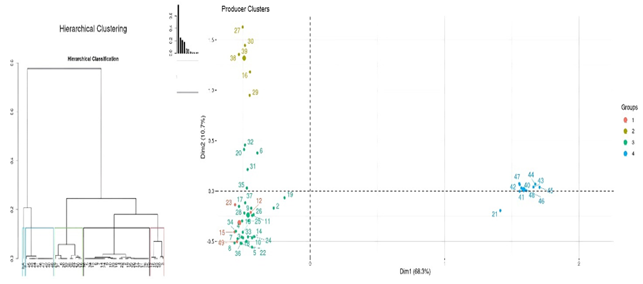
Bananas and plantains play a crucial role in food security and rural livelihoods for millions of families in Latin America and the Caribbean. However, Fusarium wilt caused by Fusarium odoratissimum (formerly Fusarium oxysporum f. sp. cubense), Tropical Race 4 (Foc TR4), threatens the sustainability of these production systems. In the absence of resistant cultivars and effective control measures, biosecurity remains the primary strategy for prevention. To assess the vulnerability of smallholder Musaceae producers, 230 surveys were conducted in Colombia, Panama, Dominican Republic, Costa Rica, Ecuador, and Nicaragua. Multivariate analyses identified vulnerability typologies based on the degree of implementation of biosecurity measures and the level of control over planting material quality. The territorial distribution of these typologies reflected the influence of institutional arrangements and phytosanitary governance. Based on these patterns, differentiated interventions are recommended according to vulnerability level: minimum exclusion measures and basic infrastructure for highly vulnerable producers; strengthened protocols, record-keeping, and access control for producers with intermediate vulnerability; and continuous surveillance and full traceability of planting material for producers with low vulnerability. This tiered strategy may contribute to reducing the risk of Foc TR4 spread in the region more effectively and in alignment with local capacities.
Downloads
References
Acuña, R., Rouard, M., Leiva, A. M., Marques, C., Olortegui, J. A., Ureta, C., Cabrera-Pintado, R. M., Rojas, J. C., Lopez-Alvarez, D., Cenci, A., Cuellar, W. J., & Dita, M. (2022). First Report of Fusarium oxysporum f. sp. cubense Tropical Race 4 Causing Fusarium Wilt in Cavendish Bananas in Peru. Plant Disease, 106(8), 2268. https://doi.org/10.1094/PDIS-09-21-1951-PDN
Azarov, A., Sidle, R. C., Darr, D., Verner, V., & Polesny, Z. (2024). A Proposed Typology of Farming Systems for Assessing Sustainable Livelihood Development Pathways in the Tien Shan Mountains of Kyrgyzstan. Land, 13(2), 126. https://doi.org/10.3390/land13020126
Betancourt Vásquez, M., Cárdenas López, J., & Rodríguez Yzquierdo, G. A. (2021). Guía para importar a Colombia germoplasma y material de propagación de plátano y banano en el marco de la emergencia sanitaria por Foc R4T en Colombia. Corporación Colombiana de Investigación Agropecuaria (Agrosavia). https://doi.org/10.21930/agrosavia.manual.7404753
Blomme, G., Mahuku, G., Kearsley, E., & Dita, M. (2024). Towards the Integrated Management of Fusarium Wilt of Banana. Journal of Fungi, 10(10), 683. https://doi.org/10.3390/jof10100683
Borja, E., Guara-Requena, M., Hoyos, M., Terrero, P., Rodulfo, P., Carvajal, L., Camacho, W., Mayorga, R., Molina, C., & Caicedo, M. (2025). Ecuadorian Littoral Musaceae Producers’ Typification Based on Their Production Systems, Agronomic Management, Biosecurity Measures, and Risk Level Against Foc TR4. Agriculture, 15(21), 2208. https://doi.org/10.3390/agriculture15212208
Dita, M., Barquero, M., Heck, D., Mizubuti, E. S. G., & Staver, C. P. (2018). Fusarium Wilt of Banana: Current Knowledge on Epidemiology and Research Needs Toward Sustainable Disease Management. Frontiers in Plant Science, 9. https://doi.org/10.3389/fpls.2018.01468
FAO. (2009). Banana market review. Preliminary results 2022. 01, 18. www.fao.org/contact-us/licencerequest.
FAO. (2024). Banana statistical compendium 2021. 2, 306–312.
Fujiwara, T., & Liu, T.-P. (2023). Contrastive multiple correspondence analysis (cMCA): Using contrastive learning to identify latent subgroups in political parties. PLOS ONE, 18(7), e0287180. https://doi.org/10.1371/journal.pone.0287180
Garcia-Figuera, S., Grafton-Cardwell, E. E., Babcock, B. A., Lubell, M. N., & McRoberts, N. (2021). Institutional approaches for plant health provision as a collective action problem. Food Security, 13(2), 273–290. https://doi.org/10.1007/s12571-020-01133-9
Ghag, S. B., Shekhawat, U. K. S., & Ganapathi, T. R. (2015). Fusarium wilt of banana: biology, epidemiology and management. International Journal of Pest Management, 61(3), 250–263. https://doi.org/10.1080/09670874.2015.1043972
Instituto Colombiano Agropecuario [ICA]. (2024). Resolución No.00002081. Instituto Colombiano Agropecuario, (0000000), 1–40. https://www.ica.gov.co/getattachment/fc57b4b9-ab28-4c1a-83c6-1c1bbbbf2d8f/2024R00002081.aspx
Izquierdo-García, L. F., Carmona, S. L., Zuluaga, P., Rodríguez, G., Dita, M., Betancourt, M., & Soto-Suárez, M. (2021). Efficacy of Disinfectants against Fusarium oxysporum f. sp. cubense Tropical Race 4 Isolated from La Guajira, Colombia. Journal of Fungi, 7(4), 297. https://doi.org/10.3390/jof7040297
Jolliffe, I. T., & Cadima, J. (2016). Principal component analysis: a review and recent developments. Philosophical Transactions of the Royal Society A: Mathematical, Physical and Engineering Sciences, 374(2065), 20150202. https://doi.org/10.1098/rsta.2015.0202
Kallow, S., Mertens, A., Janssens, S. B., Vandelook, F., Dickie, J., Swennen, R., & Panis, B. (2022). Banana seed genetic resources for food security: Status, constraints, and future priorities. Food and Energy Security, 11(1). https://doi.org/10.1002/fes3.345
Kema, G. H. J., Drenth, A., Dita, M., Jansen, K., Vellema, S., & Stoorvogel, J. J. (2021). Editorial: Fusarium Wilt of Banana, a Recurring Threat to Global Banana Production. Frontiers in Plant Science, 11. https://doi.org/10.3389/fpls.2020.628888
Kusters, K., De Graaf, M., Buck, L., Galido, K., Maindo, A., Mendoza, H., Nghi, T., Purwanto, E., & Zagt, R. (2020). Inclusive Landscape Governance for Sustainable Development: Assessment Methodology and Lessons for Civil Society Organizations. Land, 9(4), 128. https://doi.org/10.3390/land9040128
López-Zapata, S. P., & Castaño-Zapata, J. (2019). Manejo integrado del mal de Panamá [Fusarium oxysporum Schlechtend.: Fr. sp. cubense (E.F. SM.) W.C. Snyder & H.N. Hansen]: una revisión. Revista U.D.C.A Actualidad & Divulgación Científica, 22(2). https://doi.org/10.31910/rudca.v22.n2.2019.1240
Maryani, N., Lombard, L., Poerba, Y. S., Subandiyah, S., Crous, P. W., & Kema, G. H. J. (2019). Phylogeny and genetic diversity of the banana Fusarium wilt pathogen Fusarium oxysporum f. sp. cubense in the Indonesian centre of origin. Studies in Mycology, 92, 155–194. https://doi.org/10.1016/j.simyco.2018.06.003
Maugeri, A., Barchitta, M., Basile, G., & Agodi, A. (2021). Applying a hierarchical clustering on principal components approach to identify different patterns of the SARS-CoV-2 epidemic across Italian regions. Scientific Reports, 11(1), 7082. https://doi.org/10.1038/s41598-021-86703-3
Mejías Herrera, R., Hernández, Y., Magdama, F., Mostert, D., Bothma, S., Paredes Salgado, E. M., Terán, D., González, E., Angulo, R., Angel, L., Rodríguez, Y., Ortega, R., Viljoen, A., & Marys, E. E. (2023). First Report of Fusarium Wilt of Cavendish Bananas Caused by Fusarium oxysporum f. sp. cubense Tropical Race 4 in Venezuela. Plant Disease, 107(10), 3297. https://doi.org/10.1094/PDIS-04-23-0781-PDN
Mon, Y. Y., Bidabadi, S. S., Oo, K. S., & Zheng, S.-J. (2021). The antagonistic mechanism of rhizosphere microbes and endophytes on the interaction between banana and Fusarium oxysporum f. sp. cubense. Physiological and Molecular Plant Pathology, 116, 101733. https://doi.org/10.1016/j.pmpp.2021.101733
Nabahungu, N. L., Mirali, J. C., Simbeko, G., Amato, S., Mirali, G. M., Muhindo, P. M., Kitangala, C., Balangaliza, F. B., Nguezet, P.-M. D., Kintche, K., Udomkun, P., Mignouna, J., & Vanlauwe, B. (2025). Farmer typology and adoption of improved cassava production technologies in the Eastern Democratic Republic of the Congo. CABI Agriculture and Bioscience. https://doi.org/10.1079/ab.2025.0018
Pegg, K. G., Coates, L. M., O’Neill, W. T., & Turner, D. W. (2019). The Epidemiology of Fusarium Wilt of Banana. Frontiers in Plant Science, 10. https://doi.org/10.3389/fpls.2019.01395
Ploetz, R. C. (2015). Fusarium Wilt of Banana. Phytopathology®, 105(12), 1512–1521. https://doi.org/10.1094/PHYTO-04-15-0101-RVW
Presidencia de la república, & Ministerio de la agricultura y Ganadería. (2021). Decreto 43109-mag. 1–6.
Ritter, T., Álvarez, D., Mosquera, L. E., Martey, E., & Mockshell, J. (2024). A socioeconomic and cost benefit analysis of Tropical Race 4 (TR4) prevention methods among banana producers in Colombia. PLOS ONE, 19(10), e0311243. https://doi.org/10.1371/journal.pone.0311243
Roberts, J. M., Carvalhais, L. C., O’Dwyer, C., Rincón‐Flórez, V. A., & Drenth, A. (2024). Diagnostics of Fusarium wilt in banana: Current status and challenges. Plant Pathology, 73(4), 760–776. https://doi.org/10.1111/ppa.13863
Saravia Matus, S. L., Cimpoies, D., & Ronzon, T. (2013). Literature Review and Proposal for an International Typology of Agricultural Holdings. Fao, Rome, 84.
Sinha, A., Basu, D., Priyadarshi, P., Ghosh, A., & Sohane, R. K. (2022). Farm Typology for Targeting Extension Interventions Among Smallholders in Tribal Villages in Jharkhand State of India. Frontiers in Environmental Science, 10. https://doi.org/10.3389/fenvs.2022.823338
Staver, C., Delgado, R., Rojas Llanque, J. C., & Rivas, J. C. (2023). Biosecurity for small growers of local and organic export banana in Peru – seeking synergies with food safety and ecological intensification. Acta Horticulturae, (1367), 259–268. https://doi.org/10.17660/ActaHortic.2023.1367.30
Thangavelu, R., & Mustaff, M. M. (2012). Current Advances in the Fusarium Wilt Disease Management in Banana with Emphasis on Biological Control. In Plant Pathology. InTech. https://doi.org/10.5772/33775
Voora, V., Larrea, C., & Bermudez, S. (2020). Global Market Report: Bananas. International Institute for Sustainable Development - Sustainable Commodities Marketplace Series 2019, 62. https://www.iisd.org/system/files/publications/ssi-global-market-report-banana.pdf
Wang, C.-M., & Chien, K.-H. (2024). Governing pathological markets: Microbes, banana export markets, and speculative farming practices. Environment and Planning E: Nature and Space, 7(2), 609–626. https://doi.org/10.1177/25148486231199334
Downloads
Published
How to Cite
Issue
Section
License
Copyright (c) 2026 Gustavo Adolfo Rodríguez-Yzquierdo, Sindy Lorena Mojica-Ramos, Rommel Igor León-Pacheco, Gil Eduardo De Diego-Salas, Francisco Javier Fitoria-Espinoza, David Isaías Ramos-Agüero, Luis Antonio Matos-Casado, Pedro Isaías Terrero-Yépez, Mónica Betancourt-Vásquez

This work is licensed under a Creative Commons Attribution 4.0 International License.
Los autores que publican en esta revista aceptan los siguientes términos:
- Los autores conservan los derechos de autor y conceden a la revista el derecho publicación con la obra, simultáneamente licenciada bajo una licencia de Creative Commons CC By que permite a otros compartir el trabajo, pero citando la publicación inicial en esta revista.
- Los autores pueden celebrar acuerdos contractuales adicionales separados para la distribución no exclusiva de la versión publicada de la obra de la revista (por ejemplo, publicarla en un repositorio institucional o publicarla en un libro), pero citando la publicación inicial en esta revista.
- Se permite y anima a los autores a publicar su trabajo en línea (por ejemplo, en repositorios institucionales o en su sitio web) antes y durante el proceso de presentación, ya que puede conducir a intercambios productivos, así como una mayor citación del trabajo publicado (https://web-archive.southampton.ac.uk/opcit.eprints.org/oacitation-biblio.html)